
I’m a Principal Researcher at Microsoft Research AI for Science, where I’m applying Deep Learning to advance scientific discovery. Currently I'm working on retrosynthesis — the task of planning chemical reaction recipes to obtain complex drugs from simple building blocks. Earlier I worked on generative models of drug molecules — applied at Novartis with 150+ synthesized candidates — and few-shot molecular property prediction using meta-learning. I'm also serving as an Area Chair for NeurIPS and ICML.
Before joining MSR I studied Theoretical Computer Science at Jagiellonian University in Cracow, and interned at Google Brain, Tensorflight and Jane Street. Among other things, I worked on Mixture-of-Experts models, architecture search, multi-task learning and computer vision. I also had some success in competitive programming, advancing to the finals of Facebook HackerCup (top-25 worldwide), Distributed Google CodeJam (top-20 worldwide) and Google HashCode, and ranking 14th and 34th at the ACM ICPC finals. I've set problems for ACM ICPC regionals and IOI.
Papers
Chemist-aligned retrosynthesis by ensembling diverse inductive bias models
K. Maziarz, G. Liu, H. Misztela, A. Kornev, P. Gaiński, H. Hoefling, M. Fortunato, R. Gupta, M. Segler
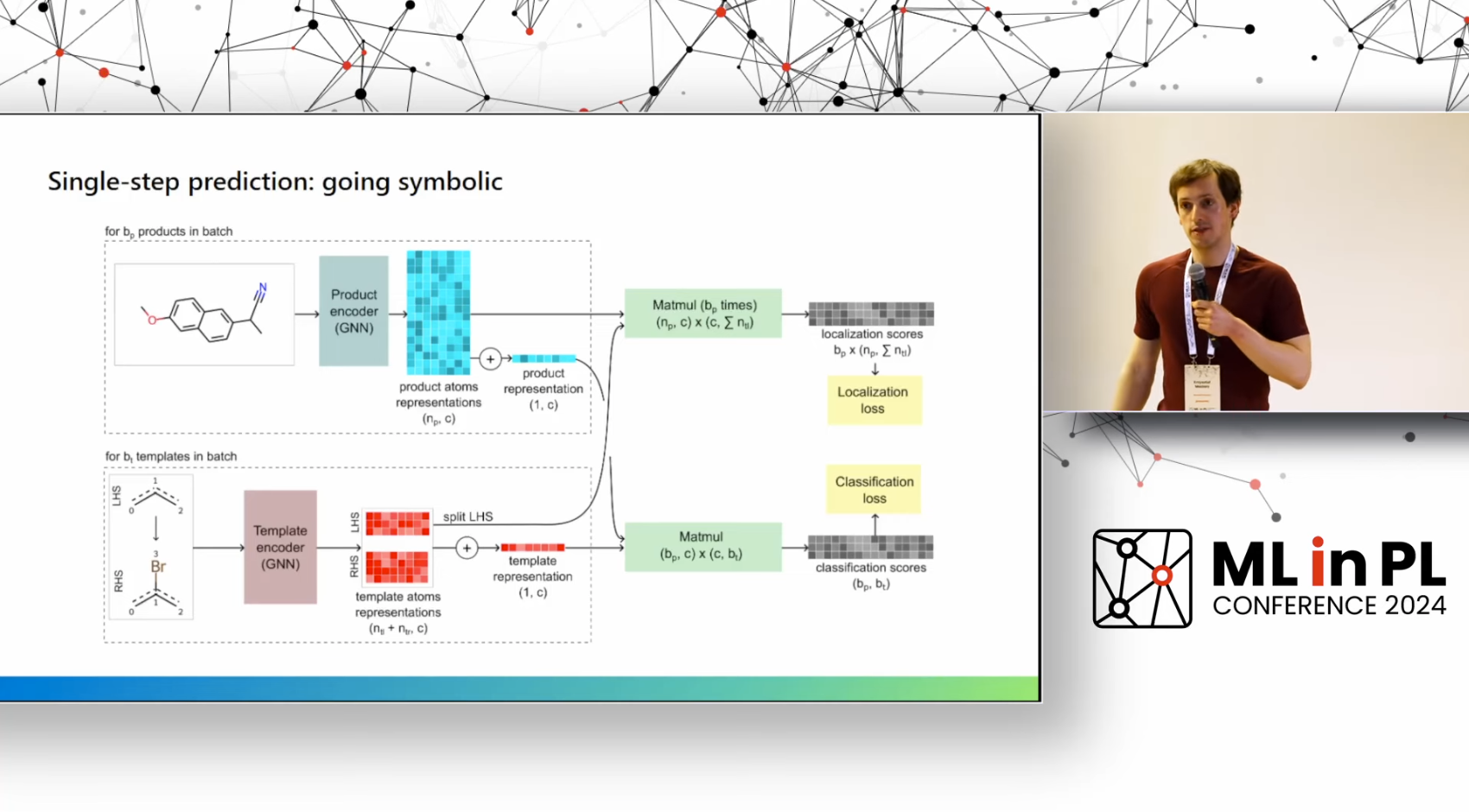
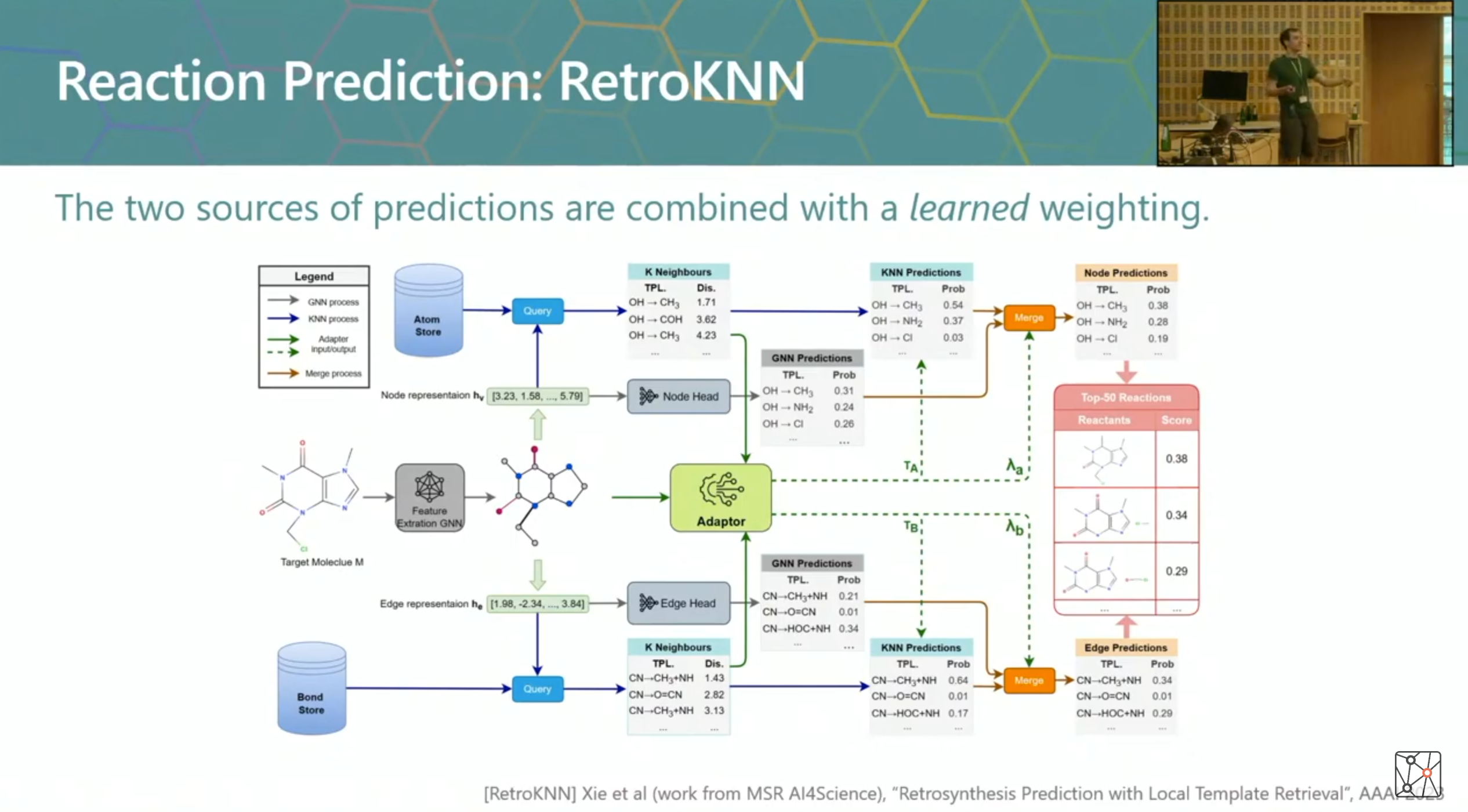
Presents RetroChimera: a model predicting reactions to synthesize a given molecule. It fuses two modules: one based on symbolic graph rewriting, and one on a large Transformer. In blind eval by chemists, outputs from RetroChimera are preferred over real patented reactions.
Re-evaluating Retrosynthesis Algorithms with Syntheseus
K. Maziarz, A. Tripp, G. Liu, M. Stanley, S. Xie, P. Gaiński, P. Seidl, M. Segler
Gives an opinionated take on best practices for retrosynthesis, and presents syntheseus — a synthesis planning library implementing them. Includes a re-evaluation of open-source reaction models, correcting discrepancies in previously published works.
Retro-fallback: Retrosynthetic Planning in an Uncertain World
A. Tripp, K. Maziarz, S. Lewis, M. Segler, JM. Hernández-Lobato
Proposes Retro-fallback: a retrosynthesis algorithm which outputs a group of synthesis plans maximizing the chance that at least one works in the lab. This is important because reactions used in these plans come from an ML model (such as RetroChimera) and can be wrong.
Retrosynthetic Planning with Dual Value Networks
G. Liu, D. Xue, S. Xie, Y. Xia, A. Tripp, K. Maziarz, M. Segler, T. Qin, Z. Zhang, TY. Liu
Advocates for separating the synthesis model for predicting valid reactions (such as RetroChimera) from the search policy selecting among them. Presents PDVN — a framework built on that idea — where the policy is trained with RL from past searches (similarly to AlphaGo).
Learning to Extend Molecular Scaffolds with Structural Motifs
K. Maziarz, H. Jackson-Flux, P. Cameron, F. Sirockin, N. Schneider, N. Stiefl, M. Segler, M. Brockschmidt
Presents MoLeR: a generative model of drugs which uses common molecular fragments as an inductive bias. It is much faster than previous models, and produces molecules of higher quality as judged by various metrics.
FS-Mol: A Few-Shot Learning Dataset of Molecules
M. Stanley, JF. Bronskill, K. Maziarz, H. Misztela, J. Lanini, M. Segler, M. Brockschmidt
Releases FS-Mol: a few-shot learning meta-dataset of molecules, comprised of 5k+ tasks related to different properties. Includes a comparison of meta-learning and multi-task learning approaches.
Outrageously large neural networks: The sparsely-gated mixture-of-experts layer
N. Shazeer, A. Mirhoseini, K. Maziarz, A. Davis, Q. Le, G. Hinton, J. Dean
Scales up sparse Mixture-of-Experts models for language modelling and machine translation. Demonstrates improving results for 60B+ parameters already in the pre-Transformer era (2016).
Contact
Easiest way of reaching me is at [firstname].s.[lastname]@gmail.com
I would not recommend doing so via LinkedIn; I get a lot of messages there and don't check them too often.